In 1989, an architectural site plan became the basis for a choreography. Zaha Hadid collaborated with Rosemary Butcher on the work d1, in which lines drawn on a surface came to organize the dancers' movements. The experiment took place when Hadid had not yet completed a permanent building and was looking for ways to materialize her investigations into space, perspective, and movement.
This episode opens a 25-year trajectory examined by the exhibition Zaha Hadid: Architecture of Performance, at the Zaha Hadid Foundation in London. Opened on November 3, 2026, the exhibition follows five international projects that brought the architect closer to dance, musical performance, and opera.
An architectural drawing transformed into a musical score.
The relationship between architecture and choreography arises from the way both organize bodies in space. A floor plan establishes paths, boundaries, directions, and areas of permanence. On a stage, these relationships can be transformed by movements performed during a specific time interval.
In her 1989 collaboration with Rosemary Butcher, Hadid's intervention consisted of bringing the language of architectural drawing to a surface traversed by dancers. Lines that could define the boundaries of a building began to guide a temporary experience. The representation ceased to function merely as a preliminary step to construction: it became part of the performance itself.
The 1990s music video pavilion
The Music Video Pavilion was commissioned for an urban festival held in Groningen, Netherlands, in 1990. Hadid chose a narrow strip between historic buildings to install the structure intended for displaying music videos.
Projections launched from a higher level fell upon platforms and surfaces of metal and glass. Three variants of the pavilion are documented in a model by Daniel Chadwick, in which ramps and perforated planes assume distinct positions. The study records alternatives for a restricted site and for the circulation of spectators.
Pet Shop Boys and the transforming stage
In the transition to the twenty-first century, stage experiences began to incorporate moving images and digital media more intensely. Hadid and Oliver Domeisen designed the set for the Pet Shop Boys' Nightlife, world tour, held between 1999 and 2000. The need to adapt the set to different venues led to the development of mobile modules.
The study maquette for the tour, preserved by the foundation, records a sequence of three connected elements. In the developed concept, a luminous surface could open, rotate, and retract, altering the relationship between stage, podium, and backdrop. In 1999 and 2000, Hadid also worked with Frédéric Flamand on the ballet Metapolis.
These experiences coincided with the expansion of the use of digital tools in the office. Drawing and modeling programs broadened the possibilities for investigating continuous geometries, while work for the stage offered an opportunity to observe the behavior of these forms in the presence of artists and spectators.
A Mozart opera with transformable costumes.
The final project in the exhibition is the production of Wolfgang Amadeus Mozart's Così fan tutte, presented in 2014 for the Los Angeles Philharmonic. Hadid's spatial conception was combined with the transformable costumes of designer Hussein Chalayan. The collaboration brought together two areas in which movement can modify the appearance of a structure: stage architecture and costume design.
By bringing together drawings, maquettes, and costumes from different periods, the exhibition allows us to observe how Hadid's ideas circulated across disciplines. The exhibition also connects these experiences to the influence of Kazimir Malevich on Hadid's visual development and the transition from analog drawing to digital modeling in her office.
From set design to permanent architecture
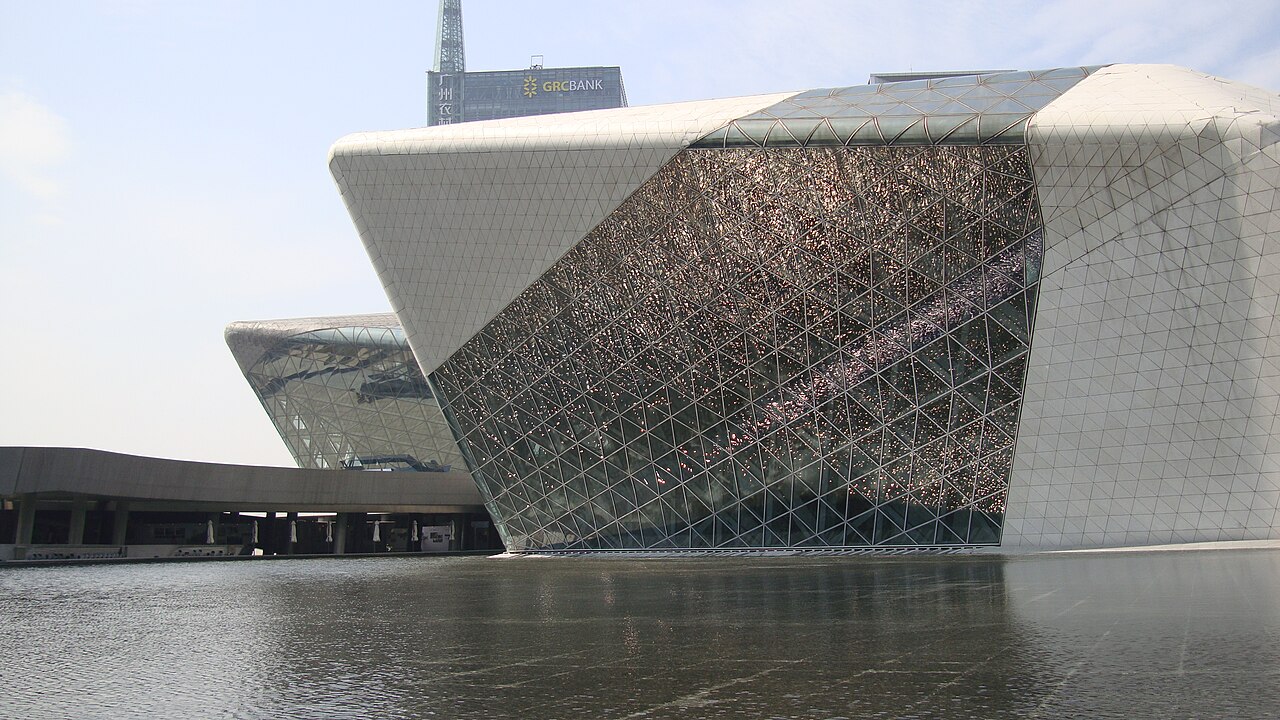
Outside the scope of the five projects in the London exhibition, the Guangzhou Opera House in China offers another chapter in this relationship with the performing arts. Developed from 2004 to 2010 for the municipal government, the work organizes two asymmetrical volumes near the Pearl River. According to the project's specifications, the arrival route integrates the complex into the urban space, with a passage incorporated into the topography leading to the building. The external forms evoke two large blocks of stone. The scale of the project is different from that of temporary stages: the architecture houses the performances and also organizes the movement of the audience before their entry into the performance space.
The Architecture of Performance exhibition in London
Curated by Catherine Howe and with Libby Sellers as guest curator, the exhibition presents archival drawings, models, digital images, photographic records, films, and costume studies. Part of its relevance lies in the possibility of examining documents produced at different moments in the architect's career.
The Zaha Hadid Foundation is located at 10 Bowling Green Lane, Clerkenwell. The exhibition is scheduled to run until March 27, 2027, with free admission and no reservation required, Tuesday to Saturday, 11 am to 6 pm. The foundation also organized a conversation dedicated to Hadid's collaboration with the Pet Shop Boys on November 5, 2026.