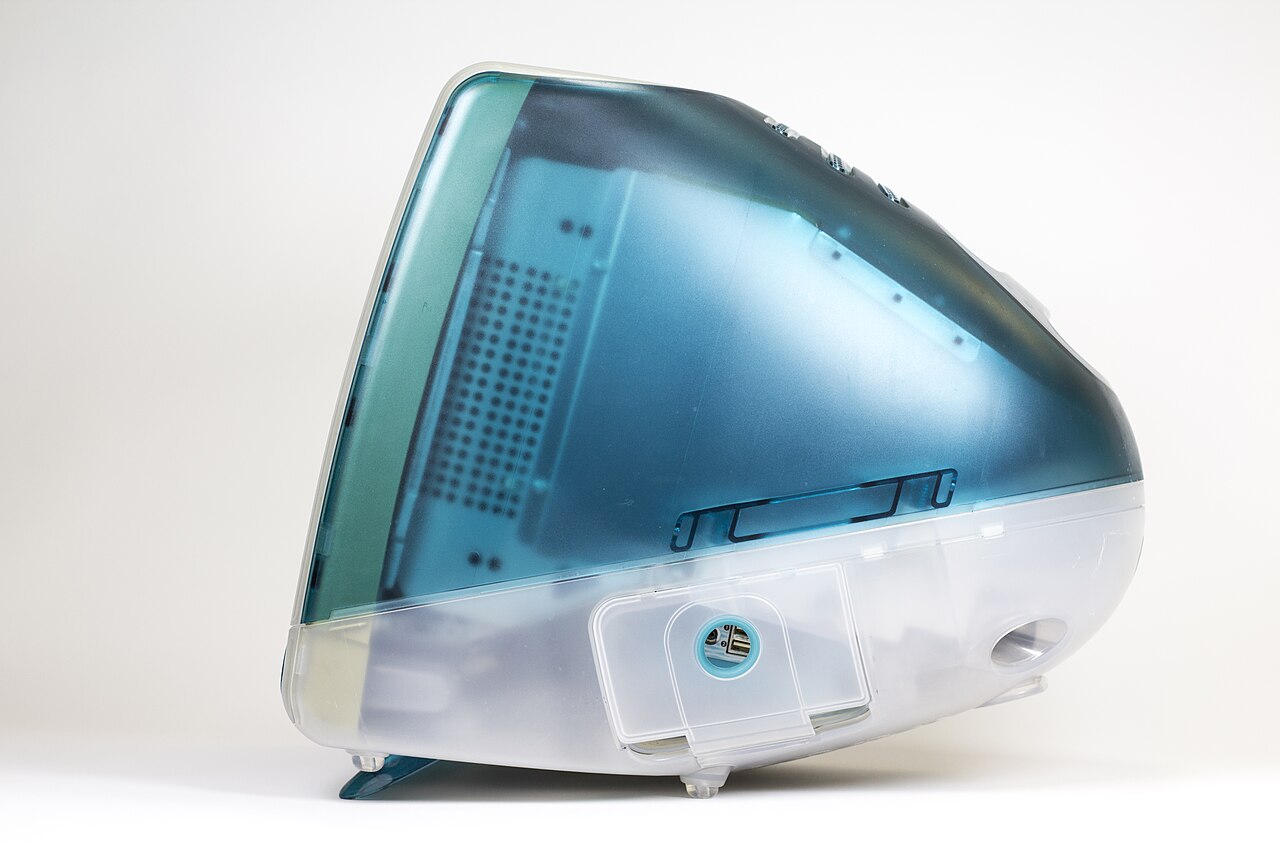
In 1986, Japanese designer Shiro Kuramata created an armchair that occupied space without obscuring what was behind it. The How High the Moon armchair was made of nickel-plated steel mesh, a material that replaced the conventional opaque volume of a seat. Twelve years later, Apple launched the iMac, a computer whose translucent casing brought another experiment with transparency to everyday life. These two objects belong to the collection of the Museum of Modern Art in New York and help to understand the variety of ideas that marked the design of the 1980s and 1990s.
Scheduled to open on January 17, 2027, Bold Is Better: '80s and '90s Design brings together nearly 150 works. The exhibition explores furniture, lighting, visual communication, fashion, and technology, drawing primarily from the museum's collections. The period is analyzed in relation to cultural changes, new means of production, and the exploration of the personality of objects.
Design and the freedom to experiment.
One of the characteristics of the period was the variety of references available to creators. The expansion of communication media and technological possibilities offered new ways of conceiving both a domestic object and its public presentation. Designers could establish relationships between historical forms and contemporary languages, incorporate humor, and investigate materials that were still unusual in furniture.
The framework announced by MoMA examines three fields: the narratives and historical references of postmodern design, its relationship with consumer culture, and experiments with materials. This perspective allows us to understand how seemingly distant ideas belonged to the same cultural environment. A garment and a chair could challenge similar conventions, even though they served different purposes.
Among the objects announced for the exhibition is the Carlton room divider by Ettore Sottsass, designed in 1981 and manufactured by Memphis in Milan. The piece uses wood and plastic laminate and exceeds 1.90 meters in height. Its geometric organization and the use of colored surfaces bring the furniture closer to sculptural composition. At the other extreme of the following decade, the Caterpillar chair, developed in 1992 by Gregg Fleishman, uses birch plywood, exemplifying the continuity of research into manufacturing and assembly processes.
The steel armchair that lets the light through.
The design of Kuramata's How High the Moon, retains the recognizable silhouette of an armchair, with a backrest, arms, and seat. Its body, however, is structured by a metal mesh. The museum piece, dated 1986 and produced by Vitra International, measures 72.4 centimeters in height, 95 in width, and 83.2 in depth.
Instead of presenting the massive appearance of an upholstered armchair, the construction reveals internal contours and allows light to pass through its surfaces. It is possible to perceive the form of a familiar piece of furniture while observing the environment through its small openings. This relationship between volume and transparency constitutes a spatial experience, as well as a material investigation.
The exploration of materials also appears in the Ghost, a glass armchair created in 1987 by Cini Boeri and Tomu Katayanagi and manufactured by FIAM Italy. The Feltri, by Gaetano Pesce, from 1986, combines felt, wood, and polyester resin. In 1992, Ingo Maurer employed glass, brass, plastic, and goose feathers in the Lucellino lamp.
When fashion transforms a traditional form.
Martin Margiela's Tabi boots are among the examples that bring together historical repertoire and the creation of an authorial language. Inspired by Japanese split-toe socks, documented by the museum since at least the fifteenth century and traditionally worn with geta or zori sandals, the designer presented his interpretation in 1988, at the first show of his brand. The example preserved by the MoMA dates approximately from 1990 and was made of leather.
In the inaugural presentation, the soles of the boots were dipped in red paint, leaving impressions on the light surface of the catwalk. The fabric marked by the footprints was reused in pieces from later collections. A functional characteristic of footwear thus became a visual motif capable of circulating among different garments.
The computer as a design object
The 1998 iMac belongs to a different field of creation: personal computers. The example in the MoMA collection uses polycarbonate and other materials, measuring approximately 38 centimeters in height and width and 43 centimeters in depth. Its integrated design and the transparency of its casing offer a different perspective on the appearance of typical home electronic equipment.
The scope of product design encompasses the interfaces through which the user recognizes and operates the technology. It also covers the place the device occupies on a desk or in a home. By associating computers and furniture pieces, the exhibition allows us to follow how productive and visual changes have impacted different aspects of the everyday environment.
Bold Is Better at MoMA
The exhibition, curated by Tanja Hwang with Amanda Forment and Paul Galloway, will be held in the Philip Johnson Galleries on the third floor of the Museum of Modern Art. The official schedule calls for a public opening on January 17 and a closing on May 22, 2027, with previews for members from January 14 to 16. The MoMA calendar contains updated visitation information.